
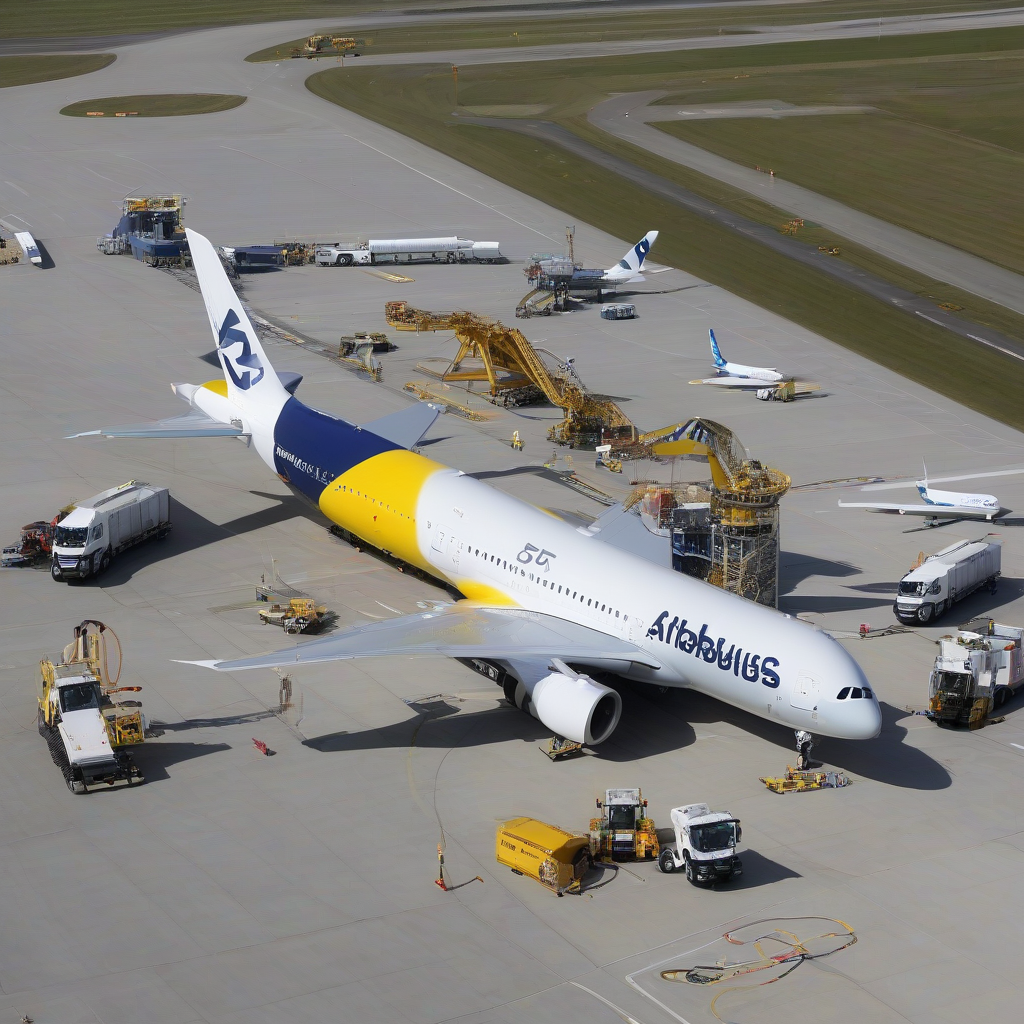
Airbus has completed a series of ground vibration tests on the A350 freighter, a critical phase in verifying the aircraft’s dynamic performance characteristics ahead of its maiden flight, according to FlightGlobal. These tests, performed throughout June, serve as a foundational requirement to confirm the airframe’s response models before the program enters the flight-testing phase.
Testing Methodology and Objectives
To validate the A350F's aeroelastic and dynamic load computations, engineers induced controlled vibrations across the aircraft structure. External inducers were strategically placed on the engines, wing-tips, and tail cone, while internal control surfaces were utilized to generate specific force responses. Airbus aeroelastics specialist Nicolas Lastere indicated that this work is essential for opening the freighter's flight envelope, as the data collected by accelerometers and on-board flight-test instrumentation allows for the refinement of element-based mathematical models.
Fabiene Ayme, an aeroelastic testing specialist, noted that control surfaces were employed to stimulate the airframe via "sine sweeps" spanning various frequencies. The manufacturer reported that the results of the ground vibration tests (GVT) aligned closely with theoretical predictions, validating the integrity of the design model.
Certification and Flight Timeline
Airbus intends to utilize two specific A350F aircraft to conduct the comprehensive certification campaign. While a precise date for the maiden flight has not been disclosed, the airframer has maintained a target to initiate flight-testing before the end of this year. Following the first flight, the program is scheduled to move into an airborne flutter testing phase within three months, during which the aircraft will be pushed to its maximum dive speed and Mach limits.
| Feature | Specification / Status |
|---|---|
| Test Period | June 2026 |
| Fleet for Certification | 2 A350F aircraft |
| Next Major Milestone | Maiden Flight (Expected by end of 2026) |
| Post-Maiden Phase | Flutter testing (within 3 months) |
Why It Matters
The successful validation of the A350F's aeroelastic model is a significant de-risking event for Airbus's entry into the dedicated freighter market. By ensuring the airframe's dynamic behavior matches digital simulations before it ever leaves the ground, Airbus reduces the likelihood of costly aerodynamic adjustments mid-flight-test. This technical precision is vital as the company seeks to compete with legacy freighter platforms. The capability to accurately predict flutter margins is essential for optimizing fuel efficiency and payload capacity—the two metrics that define the profitability of long-haul cargo operations in the current market environment.
Reader Discussion & Insights